
Vijay Mallya, who faces prosecution in India, is reportedly in London.
Tragic as it is, the submarine accident is more tactical in nature and it is the deeper strategic malaise across the board -- political, economic, security, judiciary, bureaucracy and even the media -- that has led to this dark mood of gloom and despondency, says Commodore (retd) C Uday Bhaskar.

'The Gita was propounded on a battlefield and regards the use of force to establish Dharma or righteousness, as not only legitimate but one's highest duty,' says Colonel Anil Athale (retd).

Indian property markets are not in the pink of health.

'After it was finished, Shah Jahan visited the Taj only twice.' 'There is a letter from Aurangzeb to him after a visit, reporting that the dome was leaking and needed to be fixed.' 'Shah Jahan wasn't bothered: He had moved on to designing his next project, Shahjahanabad,' reveals Aakar Patel.

Prohibitory orders were imposed in Delhi and parts of Karnataka. Police kept tight vigil in Kerala. In Gujarat, 50 people were arrested for Thursday's violence.
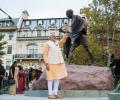
Economists expect Modi to announce big-bang reforms.

Delivering good governance is one thing and influencing culture is quite another, and this is where apprehensions about Manohar Lal Khattar arise, says Kanika Datta

Just to be clear, "love jihad" -- a concept that claims that Muslim men court Hindu women to convert them to Islam purely to take over India -- doesn't exist, says Mitali Saran

Princess Shivranjani of Jodhpur is breathing new life into dead forts and quietly changing the house of Marwar.

'We will have to wait till the snows melt in June/July 2016 before we can get a clearer idea of whether Pakistan intends to get serious about ending support for cross-border terrorism,' says G Parthasarathy, India's former high commissioner to Pakistan.
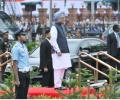
Amberish Kathewad Diwanji tweaks the prime minister's Red Fort speech.

Summary of all Ranji Trophy matches played on Saturday

The Congress on Thursday dismissed Narendra Modi's attack on Prime Minister Manmohan Singh reminding him that the country has over two-and-a-half a dozen chief ministers and rejected as "tall talk" his challenge to Singh for a public debate on pressing issues.
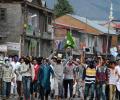
'As long as Pakistan exists, the situation will not stabilise and violence is bound to erupt from time to time.' 'Though not a final solution, a step that could help localise the abscess -- trifurcate Jammu and Kashmir state into three parts: Jammu, Ladakh and the Valley.'
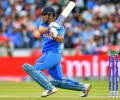
His cricketing brain, always sharp, was blessed with exceptional speed of information absorption and processing. He could quickly zero in on what needed to be done and use the element of surprise to overpower the opposition, observes Shreekant Sambrani.
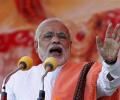
Most top industrialists rate PM's first 100 days in office as 'good', primarily due to his intentions, not concrete policy measures.

Raag Desh is one of the best films of the year, Sreehari Nair raves.

Bajirao, an unorthodox leader, faced much opposition during his lifetime from the Brahmins of Pune. In the last hundred years or so, he has been ignored due to caste politics in Maharashtra where he has become a 'non person' for having been born a Brahmin, says Colonel Anil A Athale (retd).

The government is following a path where it will not be irresponsible or profligate with public money but will intervene in the interest of the poor

Rahul Gandhi has the potential to grow into a good, effective, leader of the Opposition provided he puts his heart and soul into it, with a willingness to learn, says B S Raghavan, the distinguished civil servant who worked closely with India's first three prime ministers.

The main contest is between the CPI-M and the BJP in the February 18 assembly polls for 60 seats.
.jpg)
Modi government has taken some interesting policy decisions in the 100 days since the time he met President Pranab Mukherjee to present his claim as Prime Minister of the world's largest democracy, says Tanmaya Nanda.
.jpg)
We present Prime Minister Manmohan Singh's full speech as he addressed the country on the occasion of 66th Independence Day, from Red Fort, Delhi.

'Ishaqzaade released on May 11, 2012. It has been seven years. But if you had spoken to me on May 10, 2012, and said that I would do 13 films with so many good directors and actors, I would have said, 'Chal jhoota.''
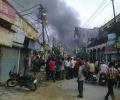
'If the BJP wants to build a minimally inclusive and secure society, in which vulnerable groups and religious minorities don't feel persecuted, then the Sangh Parivar, the party and its government must change their ways. Or else, they risk dividing India further -- violently and irreparably -- for narrow political ends,' argues Praful Bidwai.

The prime minister's August 15 address was undoubtedly inspirational and outlined important economic and social objectives, such as making India a global hub for manufacturing, ensuring bank accounts for all poor families, major thrusts in sanitation and cleanliness, and a radical restructuring of the Planning Commission.
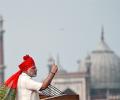
'Independence Day has been India's annual general meeting. For the most part, it has been a forgettable experience of ritual observances. Not so this year... Mr Modi instead presented what I call a moral balance sheet of India,' says Shreekant Sambrani.
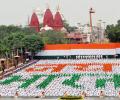
A review of key pronouncements he made in his first Independence Day Speech on August 15, 2014.

'The Opposition has no option but to make it an 'All versus One' fight to even think about winning.'

'We don't know what the reasons were that we gave back the Haji Pir Pass which was strategically very important. Today the entire infiltration into Kashmir takes place from that area. If we had retained that post that we had captured, things could have been different.' 'A lesson we need to learn is if you start losing the gains of war at the negotiating table, they become a disincentive for future wars,' says Lieutenant General D B Shekatkar (retd), reviewing the lessons from the 1965 War.

Here is a recap of all the big events that shaped the world last week.

'I believe Modi mentioned Balochistan only to embarrass Pakistan and also divert attention toward the situation in Kashmir.' 'I think from now on, India intends to raise Balochistan whenever Pakistan brings up Kashmir or upsets them on the issue of terrorism.' 'Balochistan is the least developed of Pakistan's four provinces. It is the least educated and least economically developed. People are agitated that a region so rich in mineral resources and a sea-port is still so poor.' Baloch political analyst Malik Siraj Akbar on why the province wants freedom from Pakistan.
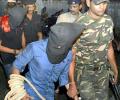
'Counter terrorism does not appear to be good guys fighting the bad ones; it is about people being picked up, detained and charged with crimes they did not commit.'
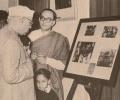
'The evidence about a plane crash that killed Netaji as stated in the Shahnawaz Committee report, is quite strong.' 'None of the files that I read bear any evidence that it was Nehru who ordered this kind of intrusive surveillance.' 'The government's excuse that declassifying some files may affect India's relations with friendly foreign countries is not a credible one.' Subhas Chandra Bose's grand-nephew and Trinamool Congress MP Sugata Bose on reports that his family was under surveillance for 20 years and the rumours over Nataji's death.
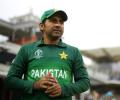
All that's transpired on and off the cricket pitch on Monday.
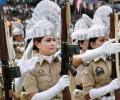
Glimpses of I-Day celebrations across India.

20 years ago this day, May 11, 1998, India conducted its second nuclear test at Pokharan in Rajasthan. In a fascinating interview on Rediff.com, K Subrahmanyam revealed how Indian PMs reacted to nuclear ambitions.
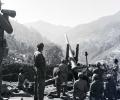
Fifty years ago, India and Pakistan fought a short but bloody war. The author finds out how Sainik Samachar, the defence ministry's journal, reported it.

Dr Pinakin Shah visited the Land of the Thunder Dragon and returned mesmerized.
